Discovering Mooting and the Advocacy Opportunities at Monash Law
Anata Gliana
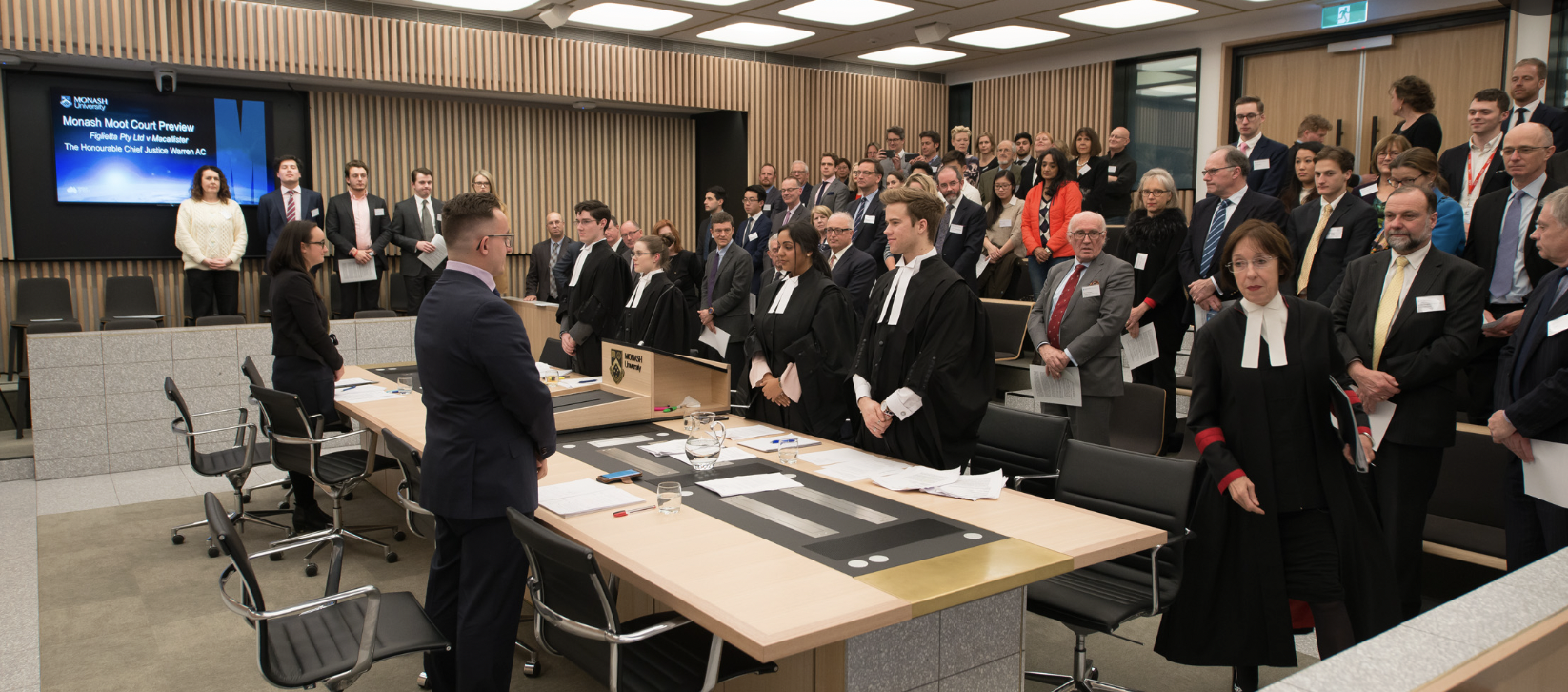
When most people imagine studying law, they probably picture lecture theatres, casebooks, assignments and, eventually, a courtroom. What is less obvious is how early you can actually begin developing the skills used inside that courtroom. For me, one of the most interesting parts of studying law at Monash has been discovering mooting.
Mooting is essentially a simulated court hearing. Often, you are in a team of three: a senior counsel, junior counsel and instructing solicitor. Students are given a legal problem and must research the relevant law, prepare written submissions and then present their arguments before a judge or panel. The experience combines teamwork, legal research, writing, advocacy and the ability to respond to questions under pressure. It sounds intimidating when you first hear about it, but that is also what makes it so valuable.
Dipping Your Toe into Mooting
One of the best things about mooting at Monash Law is that there are opportunities to start at different levels. The Monash Law Students' Society (LSS) currently runs competitions including the First Year Moot, General Moot and Women's Moot, alongside other advocacy competitions. The LSS describes these competitions as opportunities for students to develop legal research, communication, teamwork and the ability to respond to questions from the bench!
The First Year Moot is particularly useful because it gives students an opportunity to practice their advocacy skills against other students who are also just starting out. The competition is designed around the knowledge and experience of first year students, which makes it a much more approachable introduction to the mooting process. That is something I would encourage prospective students to keep in mind.
What Actually Happens When You Moot?
The preparation is probably more substantial than people initially realise. You are not just given a problem and told to argue your opinion, you need to understand the facts, identify the legal issues, research relevant authorities and develop a coherent argument. You then need to anticipate what the other side is likely to argue and prepare yourself for questions from the bench. A judge might interrupt you halfway through a submission and ask a question you hadn't anticipated. You might have prepared an answer to one issue only to find that the judge wants to explore another. You cannot simply pause and rewrite your paragraph. You have to think on the spot! That is where the real value of mooting becomes apparent.
Building Skills You Cannot Learn From a Textbook
Law school teaches you a huge amount about legal principles and reasoning, but mooting provides a different type of learning experience. You begin to understand how to communicate a complicated legal argument clearly, and learn to distinguish between the strongest and weakest parts of your case. You will also refine your public speaking skills and learn other great life skills, like listening carefully to a question before answering it. Most importantly, you become more comfortable with being challenged. These skills extend beyond advocacy, and even if you eventually decide that courtroom advocacy is not for you, those are skills that can be useful across a legal career - or any career!
From the LSS to the International Stage
This is where mooting at Monash becomes particularly interesting, because the opportunities do not stop with internal competitions. Monash Law runs a mooting and advocacy elective unit (LAW4805) and also offers students opportunities to compete in national and international mooting competitions, including the IBA ICC Moot in The Hague, the Vis Moot in Vienna and Hong Kong, the Philip C. Jessup International Law Moot in Canberra and Washington D.C., and the Oxford Intellectual Property Moot in the United Kingdom. For a university student, the idea of travelling overseas because of a law school competition is pretty remarkable. These opportunities come with months of legal research, drafting written submissions and intensive practice before competing against students from universities around the world.
From Melbourne to The Hague
Every year, a Monash team travels to The Hague in the Netherlands to compete in the IBA ICC Moot Court Competition. In 2026, after months of preparation, our Monash team finished seventh in the preliminary rounds and progressed to the quarter-finals, competing against universities from around the world. The experience involved much more than the competition itself. The team prepared extensive written submissions, participated in numerous practice rounds and appeared before panels that included international lawyers, academics, ICC staff and international judges. It is a great example of how a university extracurricular activity can develop into an international experience.
Jessup: Another Pathway into International Advocacy
The Philip C. Jessup International Law Moot provides another example. The competition involves universities from around the world and simulates a dispute between nations before the International Court of Justice. Students prepare written memorials and present oral arguments addressing complex international law issues.
In 2026, the Monash team travelled to Canberra and progressed to the quarter-finals of the Australian competition. The team competed against universities from across Australia and was judged by international law academics and legal practitioners. For students interested in international law, it provides an opportunity to experience an area of law that can feel quite distant when you first encounter it in a textbook. Suddenly, you are researching the same types of legal questions in a competitive advocacy environment.
Mooting Can Take You Further Than You Expect
There is also an important point here for students who are not completely sure what they want to do with their law degree. You do not need to know that you want to become a barrister before trying mooting. In fact, that is probably the wrong way to approach it. University is one of the few times when you can experiment with different areas of law and different forms of legal work without having to commit to a career. You might discover that you love advocacy. You might discover that you prefer research and written submissions. Or you might decide that appearing in court is not for you at all.
All three outcomes are useful. The point is to experience it rather than make assumptions about it.
Why I Would Recommend Trying Mooting
If you're considering mooting, I would not wait until you feel completely confident before getting involved. In fact, I think mooting is one of those activities where confidence comes after participation rather than before it.
Your first appearance might feel uncomfortable. You might speak too quickly. You might lose your train of thought. You might get a question that completely catches you off guard. But the next time, you are slightly more prepared. Then you become better at listening. Then you become better at responding.
Mooting is not about winning a competition. It is about taking what you learn in a lecture and testing it in a completely different environment. It gives you an opportunity to research a problem in depth, work closely with other students, receive feedback from experienced legal professionals and develop skills that cannot be fully replicated through traditional assessment.
And, for some students, it can open the door to opportunities that extend far beyond Clayton.
For me, that is what makes mooting particularly exciting. You can begin with a First Year Moot or an LSS competition, develop your advocacy skills, explore different areas of law and potentially progress into national or international competitions. You do not have to know where the pathway will take you when you start. You just have to be willing to take the first step.
Sometimes the most valuable part of studying law isn't reading about what happens in court. It's getting the opportunity to step inside the courtroom yourself!