Practical Legal Training in Victoria: What Law Students Need To Know
Alan Fu
Practical legal training (‘PLT’) involves bridging the gap between theory learnt in law school and the realities of legal practice in the real world. After graduating with your law degree, PLT is a separate process that must be completed for you to be admitted as a lawyer in Victoria.
Through a combination of coursework and work experience, PLT aims to build practical skills for graduates, allowing them to build foundational skills that prepare them to succeed as a practicing lawyer. Successful completion of PLT results in a Graduate Diploma of Legal Practice, which is a requirement for admission to practice law and become qualified as a lawyer.
PLT is compulsory, however most law students don’t start thinking about PLT until their final semester…which is usually a semester too late!
How does admission work in Victoria?
Admission is regulated by the Legal Profession Uniform Law Application Act 2014 (Vic), and the Victorian Legal Admissions Board (VLAB) is responsible for the admissions process and assessing whether law graduates are ultimately fit to be admitted.
PLT is an essential requirement for admission in Victoria alongside other requirements, such as being a fit and proper person and having graduated from an accredited law school.
The four approved providers
In Victoria, PLT is not provided by universities and cannot be completed as part of coursework for a law degree. Instead, students must choose to complete PLT from an approved provider. In Victoria, the four approved providers are The College of Law, Leo Cussen Centre for Law, ACAP University College or Swinburne University
It is important to note that FEE-HELP is available to Australian Citizens so the fees can be deferred.
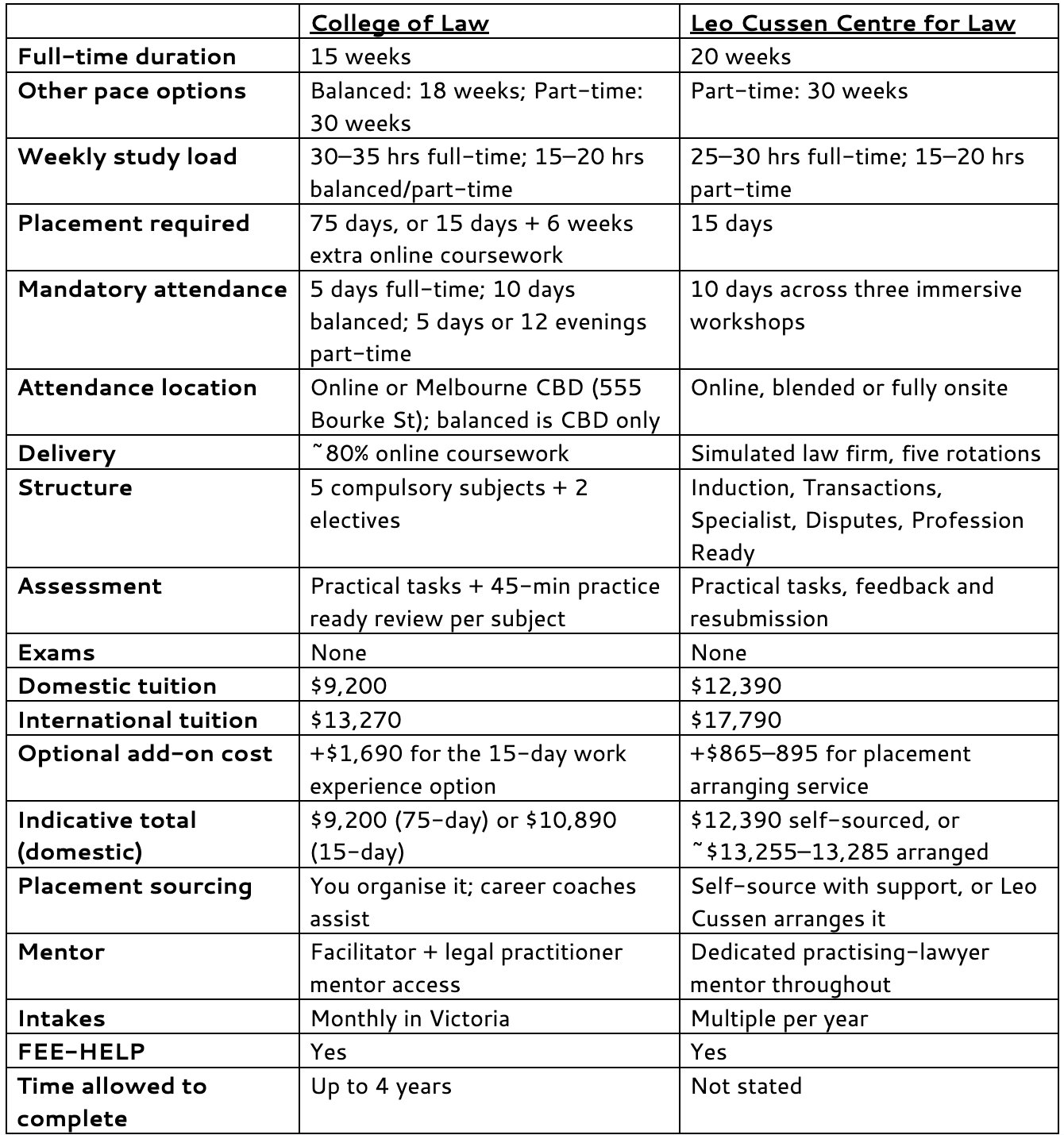
Here is a comparison between the two most popular PLT providers, the College of Law and the Leo Cussen Centre for Law:
What is the coursework actually like at PLT?
For PLT, there is no requirement for written exams. Coursework assessments mainly revolve around practical tasks. However, there is a difference in how the main two providers teach the required coursework for PLT.
At The College of Law, PLT is run based off different subjects, such as Lawyer Skills and Civil litigation practice. Leo Cussen Centre for Law takes a simulated law firm approach, with five rotations to allow students to experience various practice areas, such as disputes and transactions.
Alternative to PLT: Supervised Legal Training
In Victoria, law students can also choose to under Supervised Legal Training (‘SLT’) instead of PLT in order to fulfil the requirements for admission.
Supervised Legal Training takes place over a longer period of time with a minimum of 12 months under a training plan approved by VLAB. Instead of completing coursework at a PLT provider, SLT provides on-the-job training and gives graduates the opportunity to complete their training solely in a professional environment. Benefits of SLT include the low costs associated with completion compared with the tuition fees that must be paid in order to undertake PLT.
However, students who choose to complete SLT must also still complete certain compulsory learning modules through an approved PLT provider.
SLT is a better approach if an employer is willing and eligible to supervise you for a year and wants to structure your role around the VLAB requirements for SLT. However, most law students will undertake PLT with an approved provider to satisfy the requirements for admission.
Frequently asked questions
Completion date vs graduation date?
Completion date is the date that the university has determined that you have finished the university coursework. Graduation date is the ceremony date but is not relevant to any applications to VLAB or a PLT provider.
Can students start PLT before finishing their law degree?
You may be able to start PLT before finishing your degree if approved by VLAB, and only if you have less than two electives remaining. It is important to note that you must have completed all Priestley 11 subjects before enrolling in PLT.
Do I need a job before enrolling in PLT ?
No, you do not need a placement or job lined up before enrolling. Lots of students figure out placements during PLT. Some PLT providers may help with placements.
Can I do PLT in Victoria and practice interstate?
Yes. In Australia, admission in one state allows you to practice across Australia.
Does existing legal work experience count towards placement?
Always check with PLT provider. However, in many cases, prior legal work experience does count towards the 75-day experience requirement for PLT.
Requirements for PLT, SLT and admission can often change. Visit the Victorian Legal Admission Board website or your chosen PLT provider for more information.